To develop our IoT security solutions, we use various MCUs and evaluation boards from different vendors (Renesas, ST, SiLabs, Raspberry, MegaHunt, eWBM, etc.).
On the Renesas RA MCU family we implement our Zero Knowledge Initial Enrolment (ZKIE) architecture. It lets device manufacturers extend Zero Trust across both production and deployment of an IoT device. Our ZKIE bootloader streamlines deployment through certificateless enrolment and authentication during install, and provides a mechanism for secure OTA firmware updates in the field — even when the application layer has been compromised.

Our own platform
However, to create truly useful demo applications, proof-of-concepts, and prototypes (including for real field tests at customer sites), we have developed our own modular circuit board - the Genesis-Board.
For several customer projects and the BayStartup / Avnet / Renesas "Advanced Electronics 2025 Design Challenge" competition (electronica 2024 to embedded world 2025), we combined two Renesas evaluation boards into a monolithic circuit board. We have implemented bootloaders, bare metal applications, and an RTOS application for the two Renesas MCUs RA4 and RA8.
With Ethernet interfaces, GPIOs, debug options, and modularity for proof-of-concept and prototype implementations, we can test various (customer) applications in the future, very modularly and at short notice.
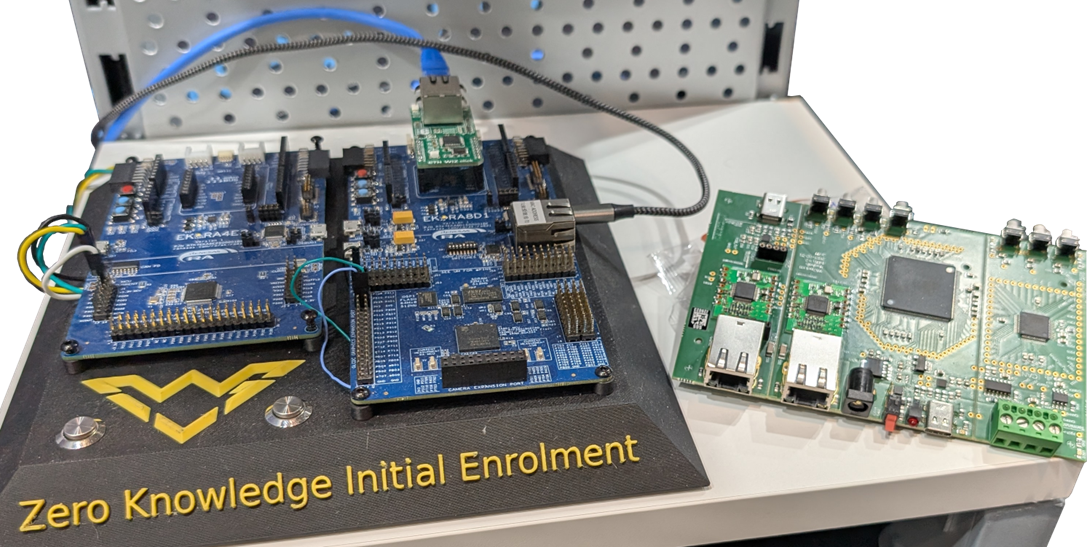
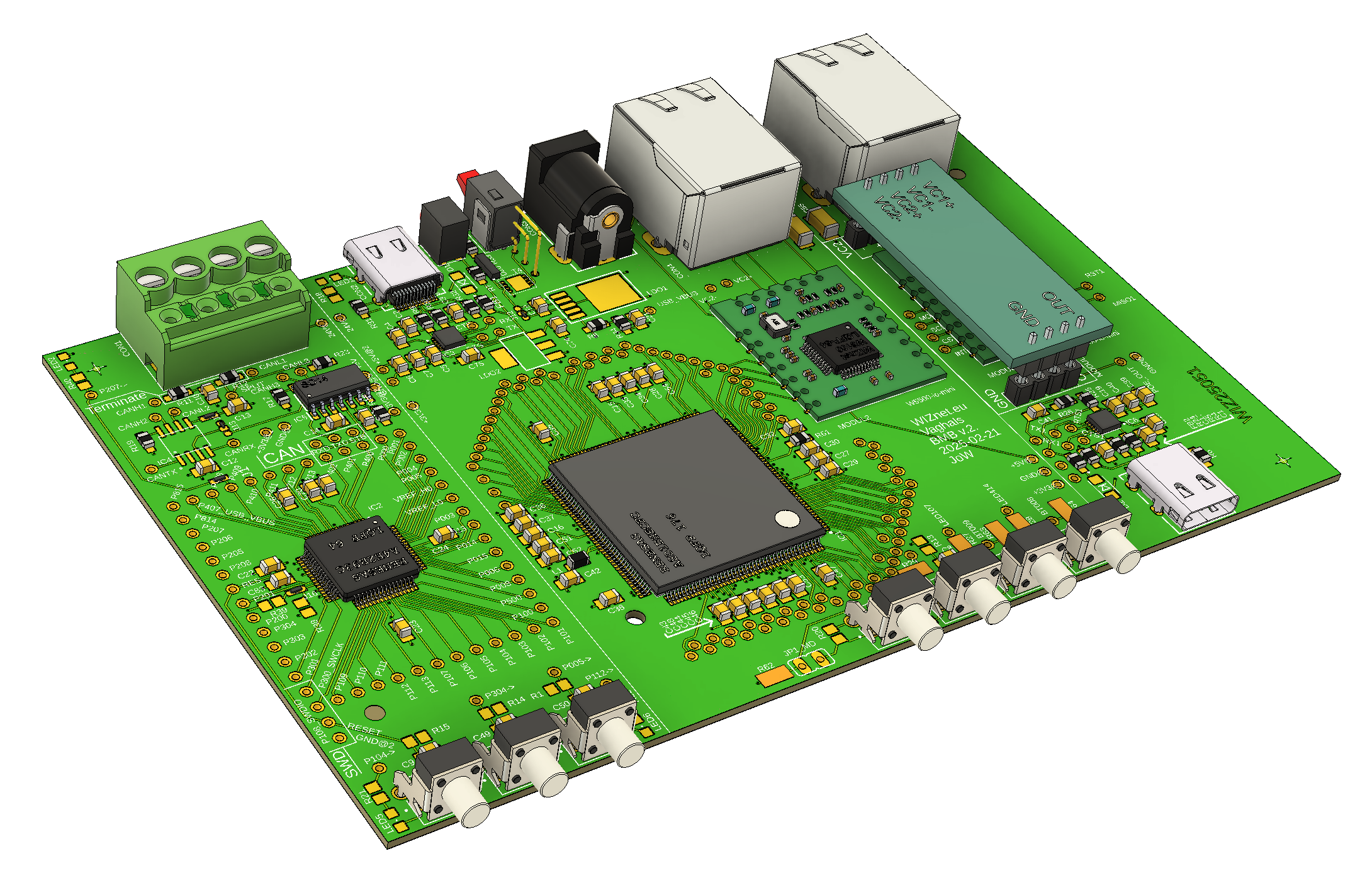
We developed the board ourselves (circuit diagram, PCB layout, etc.) and had it produced by our EMS partner Kaupke (see below) in Nuremberg, just in time for embedded world 2025.
Alongside the Renesas RA MCUs, the Genesis-Board relies on WIZnet's own hardwired TCP/IP ASICs — W5500 and W6300. Both implement the full TCP/UDP/IPv4 stack (W6300 also IPv6), ARP, ICMP, and PHY in hardware, offloading networking from the RA8D1's CPU and giving each Ethernet port its own isolated, deterministic stack — key to the bare-metal firewall design. The W5500 (SPI, ~25 Mbps) currently drives both ports; the pin-compatible W6300 (SPI/QSPI, up to 92 Mbps) removes the last throughput bottleneck for a drop-in upgrade.
The Genesis-Board as a 3D Render
The Features and Application Options
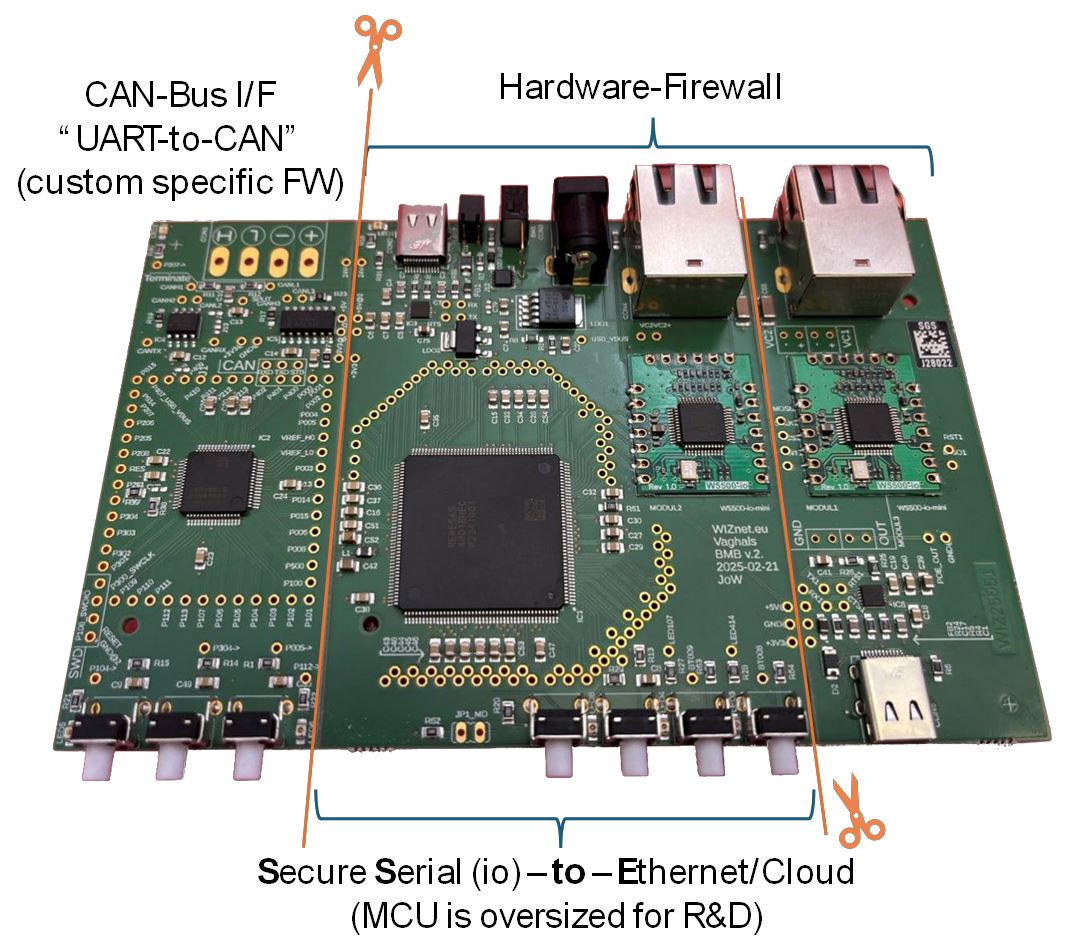
The Genesis-Board consists of three (independent) sections.
It is a printed circuit board with notches and can be split accordingly.
The middle and left parts together fit into a DIN rail housing "Bridge"
and the middle and right parts fit into an aluminum housing as a desktop device "Hardware Firewall".
- Central MCU / Middle PCB Part
- Renesas RA8D1 (the largest currently available RA MCU = oversized for research and development)
- One Ethernet interface (W5500-io module)
We will soon replace this 1:1 with the latest W6300 chip.
The W6300 (with up to 92 Mbps) eliminates all throughput limitations of the hardware firewall. - GPIOs (SPI, I2C, UART, ...) for application development
- User buttons and LEDs
- FTDI UART-to-USB-C as debug or serial user interface
(independent of the internal USB support of the MCU) - Power supply via USB-C or up to 30V via 5.5mm jack (e.g., 24V)
- The right extension
- Additional second Ethernet interface (W5500) for the hardware firewall function
(two ports = "man-in-the-middle" = firewall) - PoE (Power over Ethernet) option as a power alternative to USB-C by adding the PoE module "WIZPoE-P1"
- Another independent FDTI USB-to-UART block as an additional serial debug or user interface and power option
- The left extension
- Second MCU: Renesas RA4E2 for UART-to-CAN (custom firmware)
- GPIOs (SPI, I2C, UART, etc.) for application development
- User buttons and LEDs
- CAN interface "L" and "H"
- 24V input (can be connected to the central unit) as the main and sole power supply
Customer Demos and PoC
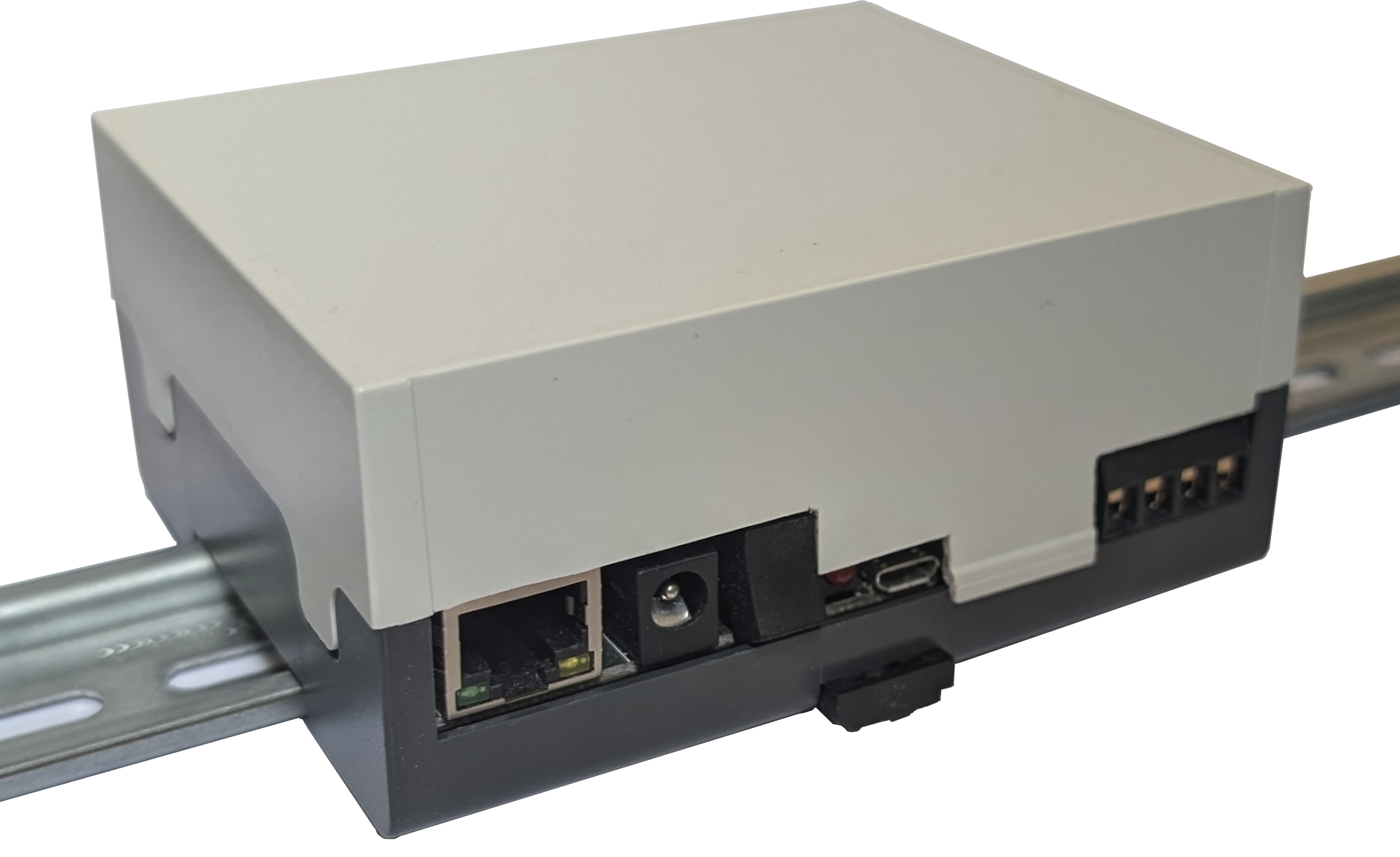
Industrial enclosures are available for both options (customer demos):
- CAN-to-Cloud Bridge in a DIN rail enclosure with three power supply options.
- With 4-wire CAN bus connection (e.g., 24V)
- 5V USB-C
- Up to 30V via 5.5mm jack
- Hardware firewall: BOPLA aluminum desktop enclosure "Alubos" with 3 power options.
This is a true bare-metal hardware firewall with no operating system, minimal firmware, and isolates vulnerable networks in an unassailable / unattackable manner. - 5V USB-C
- Up to 30V via 5.5mm jack
- Power over Ethernet (POE), isolated

Author: